UK Inflation is Far Higher than other European Countries. Why the Divergence?
The Bank of England painted last week a very sobering picture of the British #economy with levels of inflation are far higher than those registered in other major European economies. If the supply shocks are, seemingly, the same, why such a large divergence? Consider #brexit .
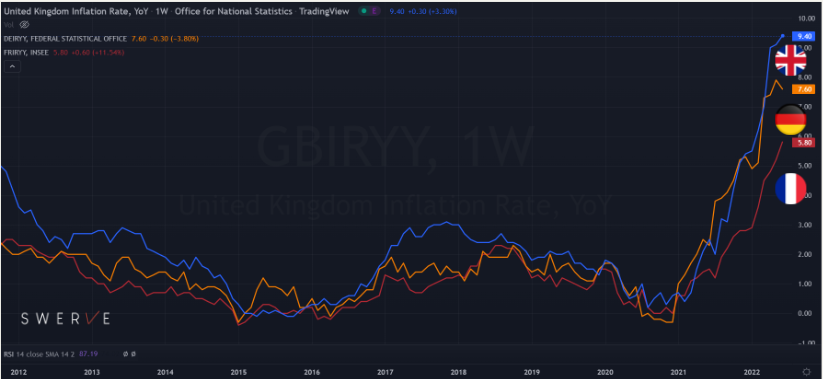
The Bank of England painted last week a very sobering picture of the British #economy . They forecast several quarters of recession and double digit #inflation . The latter has been rising to the highest levels in four decades and is expected to reach 13% at the end of the year. Such levels of inflation are far higher than those registered in other major European economies. In Germany and France inflation for the month of July was 7.6% and 5.8% respectively. Still historically high but 20-40% lower than the UK’s 9.4% (see chart). If the supply shocks are, seemingly, the same, why such a large divergence? Consider #brexit .
The key driver for higher UK inflation has been an acute labor shortage as documented by the survey of employers carried out by the Confederation of British Industry. Such shortage feeds into wages and, ultimately, into the price of goods and services. As Brexit ended the free movement of EU migrant workers to the UK, labor supply has shrunk and lost elasticity. The exit from the EU has, in essence, amplified the inflationary impact of other exogenous shocks.
#deglobalization is inherently inflationary and the UK case is a sign of things to come for the global economy. As more governments deploy policies that increase friction in the trade of goods, people and capital, rising prices are likely to persist. Moreover any central bank’s effort to stem inflation will be constrained by exceptionally high levels of debt and political expediency. History shows that, as persistent inflation feeds political and geopolitical instability, governments tend to aggravate economic conditions with more, rather than less, economic intervention. The vicious cycle continues until a new stage of political reform and innovation emerges from the remnants of the old system.
A world set in a deglobalization phase is a far different environment than what we have experienced over the last thirty years. Cognizant investors may need to completely change their strategies. The shift from “fiat” to “real” is a must and so is the adoption of more robust hedges against “tail” sovereign risk. Disclosure: Hold all assets mentioned. Not investment advice. Do your own research.